Competitor SWOT Analysis Guide: Template and Alternatives
A competitor SWOT analysis can be useful, but a four-box grid does not automatically produce a strategy. It can just as easily become a list of vague observations with no clear next step.
This guide explains how to use SWOT for competitor research, includes a template to help you organize the evidence, and looks at other frameworks that may fit your situation better.
Use it when you need to compare competitors, prepare for a positioning discussion, or decide how to respond to a changing market. The example uses a software market, but the approach can be adapted for e-commerce brands, agencies, local services, and other industries.
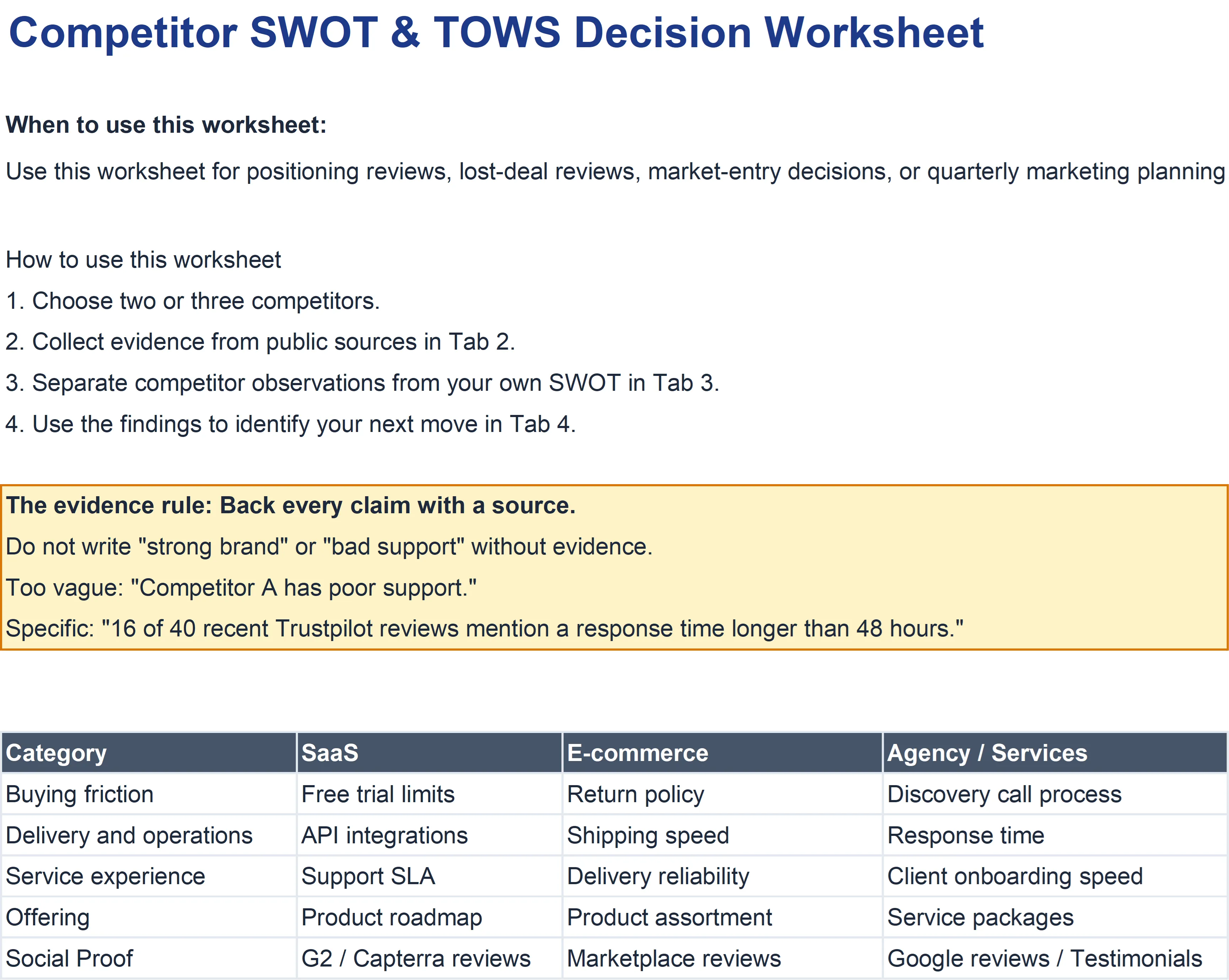
Common mistakes in competitor SWOT analysis
A SWOT grid is only useful when each point is based on evidence and leads to a decision. The following mistakes usually turn it into a list of opinions.
Treating assumptions as evidence
Avoid notes like “strong brand” or “poor customer support” unless you can point to something concrete. Use pricing pages, customer reviews, search results, sales calls, social comments, or product documentation to support each point.
For example, instead of writing “Competitor A has a strong brand,” note that it ranks for high-intent search terms, has a large review volume, or is repeatedly mentioned by customers in your market.
Mixing competitor observations with your own SWOT
A traditional SWOT is about your own business. When you analyze competitors, focus first on what you can observe: their positioning, pricing, product limits, customer feedback, and acquisition channels.
Then separate those observations from your own opportunities and threats. A competitor’s slow onboarding is an observation. Demand for faster onboarding may be an opportunity for your business. A new regulation affecting the whole category may be a threat or opportunity, depending on your position.
Stopping at the grid
The grid is not the final output. Once you have filled it in, write down what the findings mean for your next move.
You may decide to change your positioning, test a pricing message, target an overlooked audience, or improve a part of the customer experience that competitors consistently get wrong.
How to use the competitor SWOT template
Step 1: Start with the example
Open the example tab before filling in your own worksheet. It shows the level of detail to aim for and how to turn public information into short, useful notes.
Step 2: Choose up to three competitors
Pick competitors that give you a useful comparison. This may include a direct competitor, a lower-priced alternative, and a more established or niche player.
Do not choose companies only because they are well known. Choose the ones your customers compare you with, or the ones that shape expectations in your market.
Step 3: Collect evidence before you label it
Use public sources such as websites, pricing pages, product listings, review sites, social channels, search results, and customer conversations.
Write down what you can verify. A customer complaint about slow support, a minimum order requirement, or a strong search presence is more useful than a vague note like “bad service” or “strong brand.”
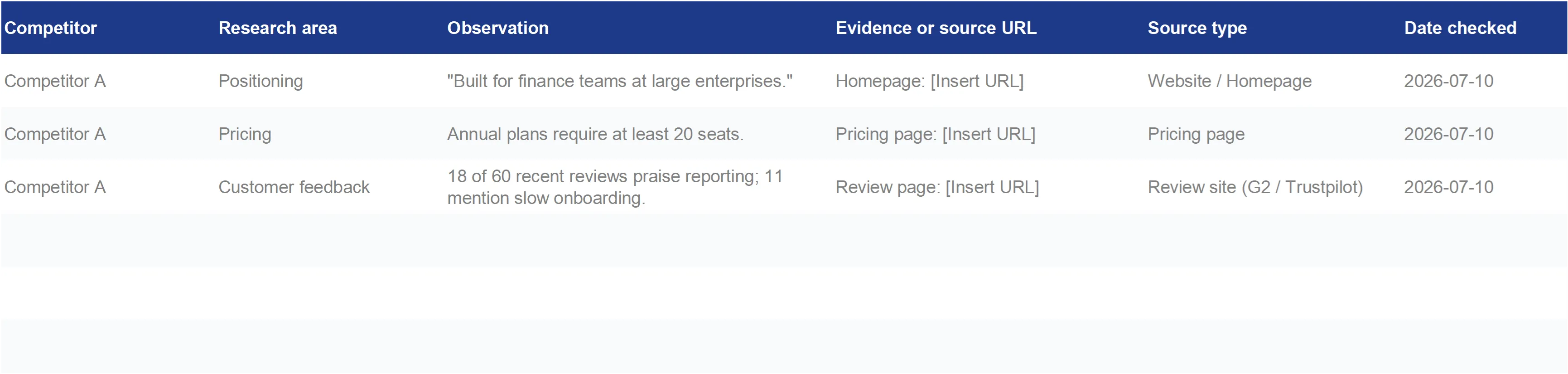
Step 4: Decide what the findings mean for you
Once the worksheet is filled in, step back from the individual competitors. Look for patterns in the market.
You may find an audience that is not being served well, a point of friction that appears across several competitors, or a pricing model that creates room for a different offer. Use those patterns to decide what to test, improve, or emphasize next.
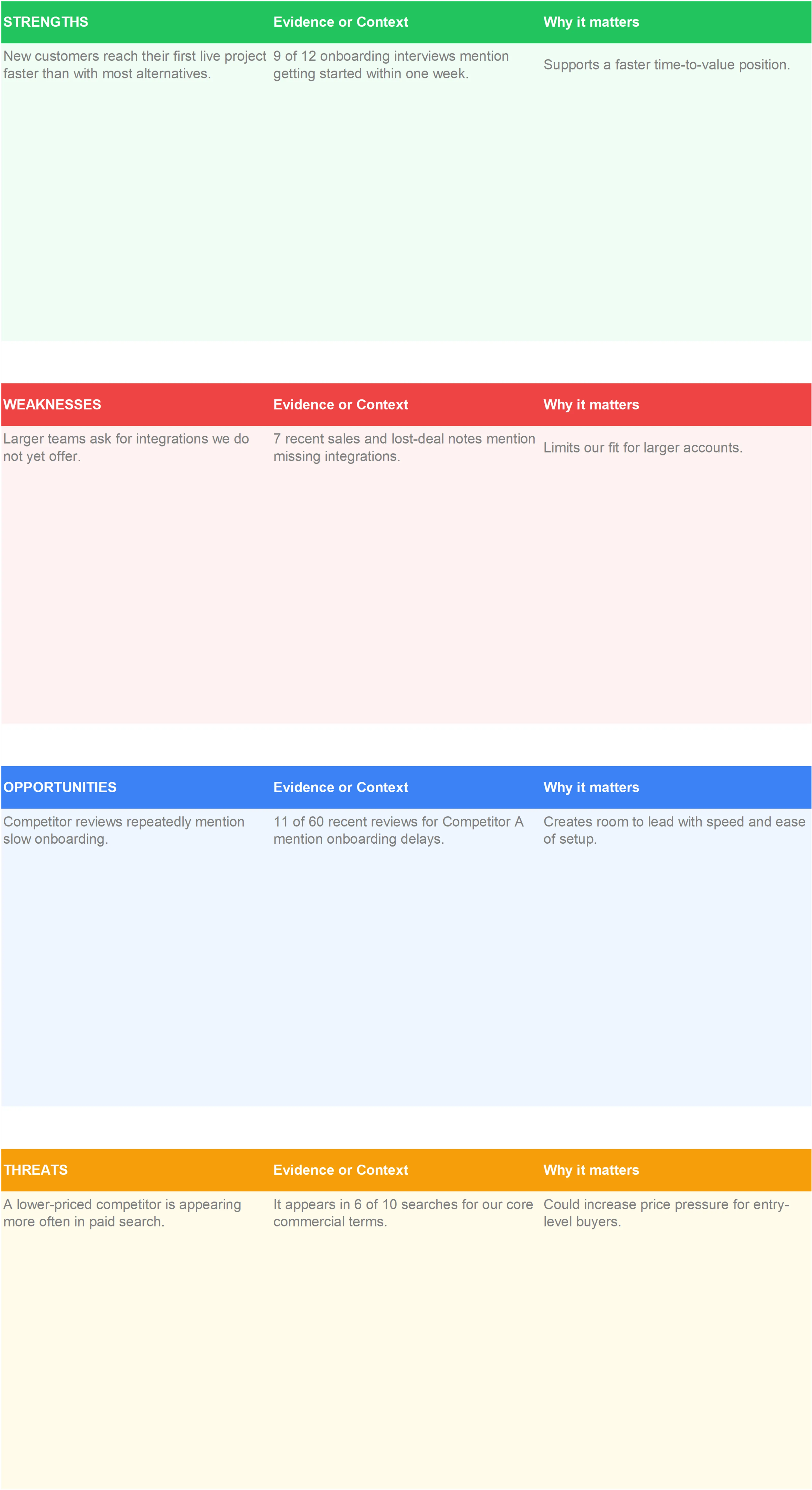
Turn competitor research into a decision
A competitor SWOT gives you a structured set of observations. The next step is deciding what those observations mean for your own business.
Use the worksheet to keep those two jobs separate. First, record what you can verify about competitors and the market. Then use the findings to identify options for your own positioning, product, pricing, or go-to-market plan.
A TOWS-style cross-match can help at this stage:
- Strengths and opportunities: Where can your existing advantages help you respond to a clear market opportunity?
- Weaknesses and opportunities: What would you need to improve or work around before you can pursue that opportunity?
- Strengths and threats: Which strengths can help you reduce a market risk or defend against a competitor?
- Weaknesses and threats: Where are you most exposed, and what should you avoid, fix, or monitor first?
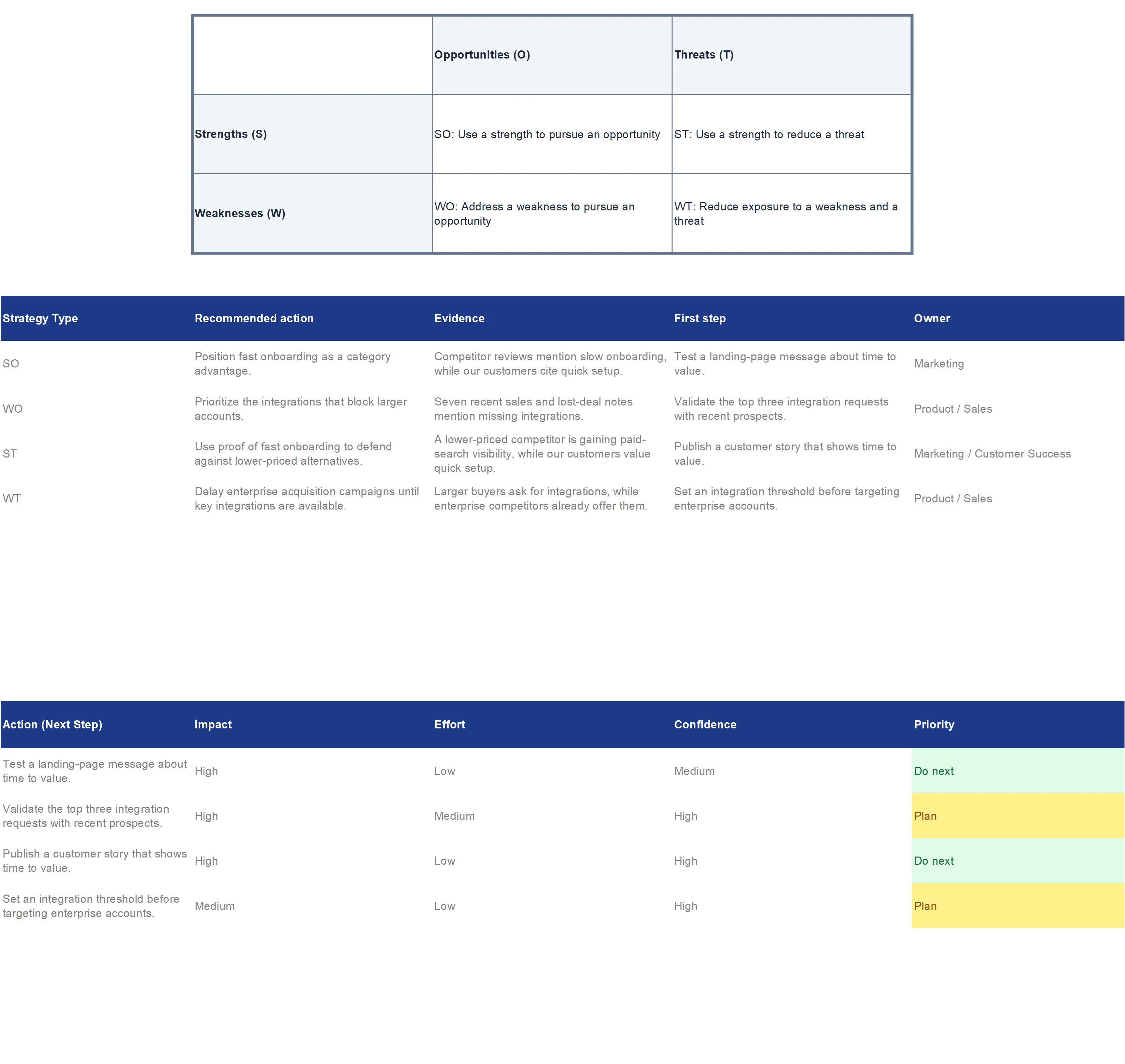
The goal is not to fill every box. It is to leave the exercise with a small number of decisions your team can test or act on.
When SWOT is not the right tool
SWOT is useful for organizing what you know. It is less useful when you need to answer a more specific question about the market, customer perception, or your next move.
Use a competitive overview matrix when you need to compare specific rivals
A SWOT summary can hide the evidence behind each point. Use a competitive overview template when you need to compare a small group of companies across the same criteria, such as positioning, target audience, pricing, acquisition channels, and customer feedback.
This works well when you need a clear picture of how competitors differ before a team discussion, campaign, or positioning review.
Use a positioning map when you need to understand perception
A positioning map helps you compare how customers may see different options in the market. Choose two factors that matter to buyers, such as price and level of service, ease of use and flexibility, or speed and customization.
It is useful when the question is not “Who has more features?” but “Where is there room for a different offer?”
Use Porter’s Five Forces when you are evaluating a market
Porter’s Five Forces looks beyond individual competitors. It helps you assess supplier power, buyer power, new entrants, substitute products, and competitive pressure.
Use it before entering a new category, launching into a new region, or deciding whether a market is attractive enough to pursue.
Present your findings
A spreadsheet is useful for research, but it is not always the clearest way to share the result with a team, client, or decision-maker.
Once you have identified the main patterns in your competitor SWOT, turn them into a short presentation. Start with the conclusion, use the evidence to support it, and finish with the action you recommend.
The competitor analysis PowerPoint template includes slides for competitor overviews, feature comparison, traffic channels, SWOT findings, and an action plan.
Competitor SWOT analysis FAQ
How often should I update a competitor SWOT analysis?
Update it when something meaningful changes, such as a new product launch, price change, major campaign, acquisition, or new competitor. For a fast-moving market, review it every quarter. For a more stable market, keep an annual version and update it when the evidence changes.
Should I create a SWOT analysis for my own business too?
Yes. Keep it separate from the competitor research.
The competitor worksheet should focus on information you can observe from the outside, such as positioning, pricing, customer feedback, and market activity. Your own SWOT can include internal knowledge, such as team capacity, product roadmap, margins, or operational limits.
Comparing the two helps you decide which gaps are worth responding to.
What is the difference between SWOT and TOWS?
SWOT helps you organize what you know. TOWS helps you decide what to do with it.
Use SWOT to identify strengths, weaknesses, opportunities, and threats. Use a TOWS-style cross-match after that to consider possible responses, such as using a strength to pursue an opportunity or reducing a weakness that leaves you exposed to a threat.